
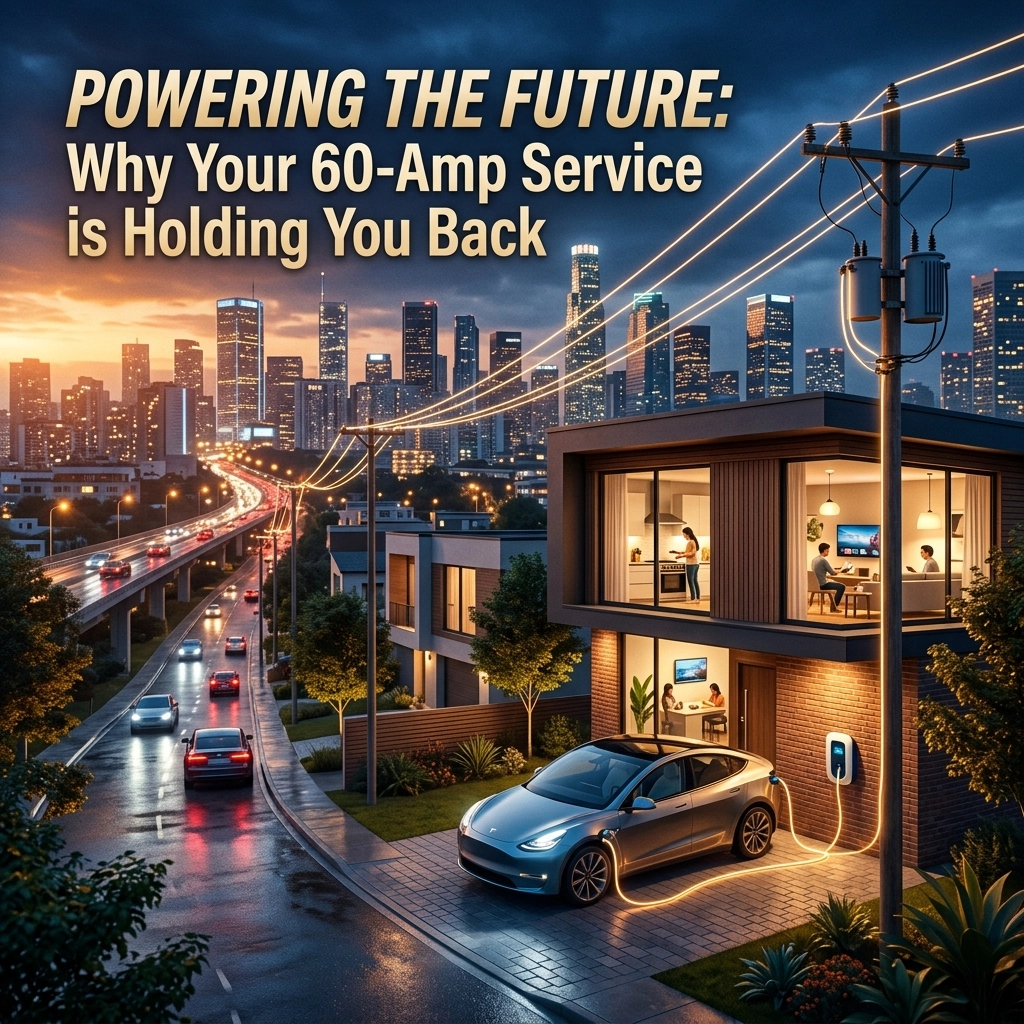
Spring in Edmonton brings a specific kind of restless energy. As the snow recedes from the River Valley, homeowners emerge from their winter slumber with grand ambitions for renovation and modernization. This year, the focus has shifted toward sustainability and high-tech integration. However, many Edmontonians residing in mature neighborhoods are discovering a significant bottleneck hidden within their utility closets. The 60-amp electrical service, once the gold standard for mid-century living, is increasingly becoming an obsolete relic that threatens both convenience and safety.
Consider the scenario unfolding on a quiet street in Glenora. Mike, an enthusiastic early adopter of new technology, recently took delivery of a high-performance electric vehicle. His neighbor, Arthur, watched from across the fence, nursing a coffee and leaning on a weathered shovel. Arthur is a traditionalist who believes that if a system worked in 1962, it should suffice in 2026.
The Conflict of Capacity
Mike’s excitement was palpable as he attempted to integrate a Level 2 charging station into his home’s infrastructure. He assumed that a simple EV charger installation would be the final step in his transition to a carbon-neutral lifestyle. Yet, the moment the charger drew power while his electric oven preheated for dinner, the entire house plunged into darkness.
"I don't understand it," Mike lamented, staring at the darkened windows of his bungalow. "The car only needs a bit of juice."
Arthur chuckled from the sidewalk. "You’re overcomplicating things, Mike. My house has run on 60 amps since the day the foundation was poured. It costs a fortune to change those systems out. Just charge the car at the mall or use a standard wall outlet. These upgrades are just a way for people to take your hard-earned money. I still use the same appliances I’ve had for decades, and my bills stay exactly where I like them."
Arthur represents a segment of the population that views residential electrical services through a lens of extreme frugality. To him, the electrical panel is a static object, not a dynamic component of a modern home. He fails to recognize that the total electrical demand of a contemporary household has tripled since the 1960s.

The Techie Perspective
Just as Mike was about to concede to Arthur’s logic, Julian arrived. Julian is the neighborhood’s resident technology expert, a man whose home operates on a sophisticated network of smart sensors and high-efficiency devices. He is also a committed vegan who views every home system as an ecosystem that requires balance.
Julian looked at the charging cable snaking across Mike’s garage floor and then at the aging exterior service entrance. He shook his head slowly.
"All for nothing, eh?" Julian remarked, his tone casual but firm. "You’re trying to run a marathon on a set of lungs designed for a stroll in the park. A 60-amp service provides roughly 14,400 watts of total power. Your electric range consumes about 12,000 watts when the oven and burners are active. Throw in a clothes dryer and your new EV charger, and you aren't just pushing the limit; you are inviting a catastrophic failure of your electrical panel capacity."
Arthur scoffed. "It’s just a few wires, Julian. Don't be dramatic."
Julian didn't blink. "I'm vegan, but if I were you, I wouldn't go cheap, protect your meat. In this case, your 'meat' is the safety of your home and the lifespan of your expensive electronics. An undersized service creates voltage drops. Those drops cause your gadgets to run hot and fail prematurely. In Edmonton, we see this constantly during the spring when people start planning their summer air conditioning installs. You cannot add a modern cooling system to a 60-amp service without sacrificing something else: usually your peace of mind."
Why 60 Amps Is No Longer Sufficient
To understand why an Edmonton service upgrade is necessary, one must look at the mathematics of amperage. Most modern homes are now built with a 200-amp service as the baseline. This allows for a "concurrent load": the ability to run multiple high-draw appliances simultaneously without tripping the main protection device.
In a 60-amp home, the margin for error is non-existent. When you engage a high-amperage device, the resistance in the old wiring increases, leading to heat generation. Over time, this heat degrades the insulation of the conductors. Furthermore, insurance companies have become increasingly wary of limited services. Many providers in Alberta now mandate an upgrade to at least 100 or 125 amps before they will issue or renew a policy. They recognize that a 60-amp system in a 2026 household is a fire hazard waiting for a busy Tuesday evening to manifest.

Planning Your Upgrade
When considering an upgrade from 60 to 100 or 200 amps, the process involves more than just swapping components. It requires coordination with the City of Edmonton’s permitting office and the local utility provider, EPCOR.
- Evaluate Your Future Needs: Do not merely upgrade to 100 amps if you plan on adding an induction stove, an EV charger, and a workshop in the garage. A 200-amp service provides the necessary headroom for future technological shifts.
- Consult a Professional: Identifying the existing limitations of your service entrance is critical. Sometimes the mast on the roof or the underground lateral lines also require replacement to handle the increased current.
- Prioritize Safety Over Cost: While Arthur may complain about the initial investment, the long-term cost of an electrical fire or damaged appliances far outweighs the price of a professional installation.
- Consider Modern Amenities: Features like whole-home surge protection and AFCI (Arc Fault Circuit Interrupter) protection are much easier to integrate during a full service upgrade.
The Spring Planning Window
Spring and summer are the ideal seasons for this work in Edmonton. Trenching for underground lines is significantly more efficient when the ground is not frozen, and scheduled power outages for the cut-over are less disruptive when the outdoor temperature is mild.
Julian continued his explanation to Mike and Arthur. "Think about your induction stove, Mike. It’s faster and safer than gas, but it demands consistent, high-amperage power. If you stay on a 60-amp service, you are essentially telling your home to choose between eating a hot meal and charging your car. That is an unnecessary compromise in 2026."
Mike looked at his darkened house and then at his new car. The realization set in that his home's "circulatory system" was clogged. He needed more than just a quick fix; he needed a foundation that could support his lifestyle.
Arthur remained skeptical, but even he couldn't ignore the dimming lights in his own living room as his vintage refrigerator kicked into its cooling cycle. The world is moving toward an all-electric future. Whether it is the integration of advanced smart home systems or the transition to electric transportation, the demand for power is only going in one direction: up.

Technical Considerations for the 12th-Grade Reader
The impedance of an aging 60-amp service often leads to significant voltage fluctuations. When a motor-driven appliance, such as a vacuum or a refrigerator compressor, initiates its start-up sequence, it requires a momentary surge of current. In a constrained system, this surge creates a momentary dip in the available voltage for the rest of the house. This phenomenon, known as "brownout," is particularly damaging to sensitive microprocessor-controlled devices.
By upgrading to a 200-amp service, you effectively increase the "pipe size" through which electrons flow. This reduces the internal resistance of the system and ensures that even under heavy load, the voltage remains stable at the required 120/240-volt levels. This stability is the silent protector of your home’s most expensive assets.
As Julian walked back to his electric truck, he offered one last piece of advice to Mike. "Don't wait for the system to fail during a heatwave. Plan the transition now. Ensure your infrastructure matches your ambition. Truly, it's the only way to future-proof your investment."
Mike nodded, finally understanding that the "cost" Arthur worried about was actually an investment in safety and modern functionality. In a city like Edmonton, where our homes are our sanctuaries against the elements, having a robust electrical service isn't a luxury: it is a fundamental requirement for the modern age. Avoid the pitfalls of an overloaded system and ensure your home is ready for whatever the future brings. Observe the capacity of your current panel and make the choice to move forward. After all, you wouldn't try to power a skyscraper with a flashlight battery; don't try to power a 2026 lifestyle with a 1950s electrical service.