

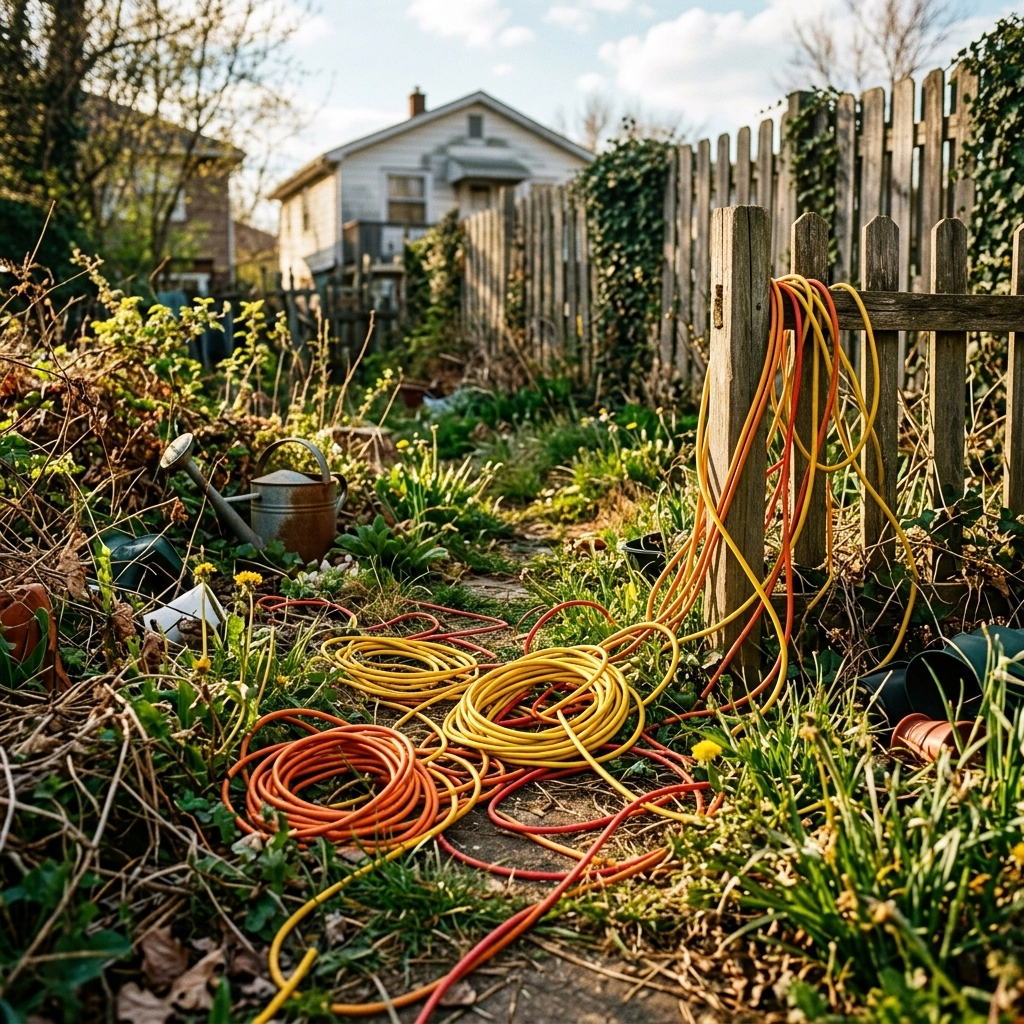
Edmonton springs are notoriously deceptive. One afternoon, the sun radiates with the nascent promise of summer, and the next, a localized blizzard reminds every resident that the North Saskatchewan River remains largely encased in ice. During this transitional period, a phenomenon known as "Spring Fever" grips the suburban landscape. Homeowners emerge from their winter hibernation, wielding pressure washers and leaf blowers like technological scepters, eager to erase the grime of a long Canadian winter.
Neighbor 1, whom we shall refer to as Gary, is the undisputed sovereign of the shortcut. Gary views the Canadian Electrical Code as a series of mere suggestions designed to impede his productivity. This morning, Gary determined that his driveway required a comprehensive de-gritting to remove the accumulated salt and gravel. However, Gary’s outdoor receptacle is situated on the distal side of his garage, far beyond the reach of his heavy-duty pressure washer’s factory cord.
Instead of relocating the machine or commissioning the installation of a dedicated outdoor outlet, Gary constructed what he proudly designates the "Power Snake." This monstrosity consists of four disparate extension cords, including one visibly intended for low-draw indoor lamp use, daisy-chained together. This vibrant orange and green serpent slithers across the muddy lawn, its various connections submerged in the icy puddles formed by the melting snowpack.

Neighbor 2, Arthur, observed this display from across the property line. Arthur is a man who maintains a profound reverence for the past and a deep suspicion of modern utility costs. He leaned on his rake, squinting at Gary’s precarious setup with a mixture of annoyance and thrift-driven concern. "You’re spinning the meter at a record pace with that contraption, Gary," Arthur bellowed. "I fail to comprehend the necessity of all that hydraulic pressure. In my era, a stiff broom and fundamental elbow grease sufficed. These modern safety outlets you had installed, the ones featuring those redundant reset buttons, likely consume more in phantom power than they contribute in utility."
Arthur’s skepticism regarding contemporary safety apparatus, such as Ground Fault Circuit Interrupters (GFCIs), is a recurring theme in the neighborhood. He perceives the mandate for GFCI protection in damp environments as a clandestine conspiracy by contractors to inflate project expenditures. He remains oblivious to the fact that in the realm of Edmonton electrical safety, those "redundant buttons" represent the primary defense preventing Gary from becoming a human conductor. As Gary stands in a conductive slurry of melting snow while gripping a metal spray wand, his safety is entirely dependent on the integrity of his home's electrical infrastructure.
The physics governing Gary’s Power Snake are precarious at best. Extension cords are not engineered for serial connection over extended distances. This configuration precipitates a significant voltage drop, which compels the pressure washer’s induction motor to operate under excessive stress. This generates internal thermal energy that can permanently degrade the equipment’s windings. More critically, the junctions where the cords interface are not hermetically sealed. As the "snake" rests in the slush, moisture infiltrates the plug terminals. Without a functional GFCI to monitor the current balance, electricity could easily find a path to the ground through the saturated soil, or through Gary himself.

Enter Neighbor 3, Leo. Leo arrived on the scene in his high-performance electric SUV, the silent hum of the drivetrain barely perceptible over the cacophony of Gary’s roaring pressure washer. Leo stepped out of the vehicle, adjusting his premium vegan leather jacket. He is the resident technophile, his residence adorned with bifacial solar arrays and a sophisticated battery storage system that allows him to remain independent of the grid during peak pricing.
Leo surveyed the Power Snake and exhaled a sigh of exasperated disbelief. He approached the fence where Arthur was still calculating the perceived financial loss of Gary’s energy consumption. Leo observed the submerged cord connections and then turned his gaze toward Gary, who was blissfully rinsing the mud-caked undercarriage of his truck.
"All for nothing, eh?" Leo shouted, his voice cutting through the mechanical din. "You are courting a catastrophic fault just to remediate some superficial grit. I’m vegan, but if I were you, I wouldn't go cheap, protect your meat."
Arthur blinked in confusion. "Protect his what?"
"His physical person, Arthur," Leo clarified, gesturing toward the electrified puddle. "That circuit is a blueprint for disaster. If those connections short-circuit while he is maintaining contact with that metal wand in a conductive environment, the current will not discriminate based on his weekend objectives. Outdoor power safety is not merely about regulatory compliance; it is about fundamental biological preservation when interfacing with high-voltage systems in a damp exterior setting."
Leo articulated that while Arthur focused on the marginal cost of kilowatts, the true hazard lay in the potential for a permanent failure of the home’s electrical system or a life-threatening cardiac event for Gary. He noted that even the residential electrical services performed by qualified professionals emphasize that extension cords are intended for transient use and should never serve as a permanent surrogate for fixed wiring.

In the Edmonton region, the substrate remains saturated for weeks after the visible snow evaporates. This moisture significantly enhances the conductivity of the ground, elevating the risk of electrical shock during spring maintenance rituals. A professional installation would involve weather-resistant receptacles encased in "extra-duty" in-use covers, ensuring that the interface remains shielded from precipitation and runoff even while a plug is inserted.
Gary, finally noticing the gathering at the fence, disengaged the pressure washer. "What is the source of the commotion? It is merely water, and the cord features industrial-grade insulation!"
"The insulation is irrelevant at the unsealed terminals where you have bridged the cords," Leo countered. "You have essentially constructed a series of exposed electrical bridges over a lake of electrolyte-rich slush. I would suggest you investigate the necessity of surge protection and proper grounding protocols before you compromise your motor or your heartbeat."
Leo’s eccentric advice to "protect your meat" resonated with the group. He understands that the human anatomy is fundamentally a vessel of saline fluid: a superlative conductor of electricity. When operating outdoor electrical systems, the margin for error is non-existent.
The Canadian Electrical Code is remarkably explicit regarding these environmental conditions. It mandates GFCI protection for all exterior receptacles because these devices are calibrated to detect a current leakage as minute as 5 milliamperes. Upon detection, they terminate the power flow in a fraction of a second, long before the current can inflict physiological damage. Without this protection, Gary’s "Power Snake" is a dormant threat waiting for a specific threshold of moisture to trigger a fault.

Arthur remained marginally skeptical regarding the installation costs, yet even he conceded that the sight of a submerged orange cord emitting a faint localized hiss in a puddle was disconcerting. "I suppose a proper outlet is more cost-effective than an emergency room deductible," he muttered, finally acknowledging the merit of modern safety standards.
Gary looked at his Power Snake, then at his saturated footwear, and finally at the sophisticated solar infrastructure on Leo’s roof. He realized that his perceived shortcut was an inefficient and hazardous gamble. He began the laborious process of disconnecting the cords, ensuring each terminal was thoroughly dried before coiling them for storage.
Spring in the capital region should not be characterized by preventable hazards. It is a season for the rejuvenation of property and preparation for the fleeting summer months. Ensuring that your outdoor power safety is optimized is a critical component of that seasonal transition. You may consult various electrical safety standards to ensure your garden does not inadvertently become a habitat for "Power Snakes."
Leo watched Gary retreat into the safety of his garage with a slight, knowing smile. He adjusted his jacket and turned to Arthur. "Success is predicated on the integrity of the infrastructure, Arthur. You cannot sustain a digital-age lifestyle on a compromised analog foundation."
Arthur grunted, returned to his rake, and continued his battle against the dead grass. The Power Snake was dismantled, the puddles remained, and for the duration of the afternoon, the neighborhood remained both powered and secure.